





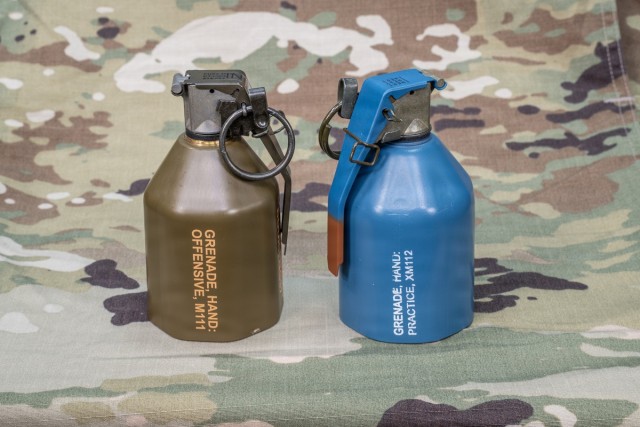
Officials with the U.S. Army announced the approval of a new hand grenade, the M111 Offensive Hand Grenade for Full Material Release, the first new lethal hand grenade in nearly six decades.
Developed by the Capabilities Program Executive Ammunition and Energetics (CPE A&E) in conjunction with the U.S. Army Combat Capabilities Development Command Armaments Center at Picatinny Arsenal, the new grenade will replace the older Mk3A2 series. The Mk3A2 is restricted for use because of its asbestos body. The M111 uses a plastic body that is fully consumed during detonation, officials said.
Additionally, officials said the M!!! provides increased training and operational readiness and provides a safer option for soldiers to use. Because it uses blast overpressure instead of fragmentation to deliver lethality, the new grenade is more effective in closed quarter urban environments, the Army said. BOP provides devastating effects to enemy personnel and equipment and gives soldiers a potential tactical advantage in the field M67 fragmentation hand grenade sends out lethal and incapacitating fragments that can be deflected when used in enclosed, restricted terrain like buildings and rooms. The M111 explosions are less affected by obstacles in enclosed and restricted terrain, officials said.
“One of the key lessons learned from the door-to-door urban fighting in Iraq was the M67 grenade wasn’t always the right tool for the job. The risk of fratricide on the other side of the wall was too high,” Col. Vince Morris, Project Manager Close Combat Systems, CPE A&E, said. “But a grenade utilizing BOP can clear a room of enemy combatants quickly leaving nowhere to hide while ensuring the safety of friendly forces.”
Army officials said soldiers will use the M67 in open terrain to maximize lethal fragmentation effects, but will use the M111 in smaller and enclosed spaces.
“We’ve given our Soldiers and joint warfighters the flexibility to determine in the field which type of grenade will best suit the current situation they are facing, be it open space or confined area,” Tiffany Cheng, one of the DEVCOM Armaments Center engineers that developed the M111 at Picatinny Arsenal, said.
A major benefit of the M111 design is that it and its training version, the M112, use the same five-step arming process, allowing the Army to use the same fuses as they have used before in the M67 and its training version the M69. Using the same fuses saves costs by leveraging economies of scale while sourcing. The grenades also have government-owned intellectual property that allows the Army to compete production contracts across the industrial base, enhancing production opportunities while providing the best value.
“By standardizing the arming process and the fuzing, the Army saves taxpayer money without sacrificing lethality on the battlefield,” Morris said. “This is the kind of acquisition reform that is currently underway throughout the Army acquisition enterprise. We are taking advantage of that initiative to drive down costs while increasing combat effectiveness.”